
Columbia County Court Records After Arrest
A Columbia County jail arrest record and a Columbia County court record answer different questions. The Columbia County Detention Center records the intake event, including the name, intake date, arresting department, booking-style charges, and bond data visible on the sheriff-linked ISOMS roster. The court record starts when the case is opened or indexed by the court after a prosecutor, officer, or grand jury files a charging document. From that point, Search ARCourts and the clerk record are the better source for filed charges, hearings, dispositions, judgments, and future events.
The local court office for filed case records is the Columbia County Circuit Clerk, Lisa C. Lewis. The county research identifies the Circuit Clerk, Probate & Recorder office at 1 Courthouse Square, Ste. 3, Magnolia, AR 71753, with phone 870-235-3700. The office matters because Search ARCourts can show public case information, but clerk staff remain the source for case-specific copy, certification, filing, and document questions. For the custody side of the same event, use Columbia County jail inmate records; for the booking photo side, use Columbia County jail mugshots.
Find Columbia County Arrest Court Records
The first online court route is Search ARCourts, the Arkansas Judiciary public case-information portal. The Judiciary describes it as a way to search public case information in courts using the Contexte case-management system. For Columbia County court records after a jail arrest, search by participant name first, then narrow the result by county, court location, date range, case type, or case number when those filters are available. A new jail booking can precede court indexing, so a missing same-day result does not prove no case will be filed.
The Search ARCourts case-search interface is the statewide screen used before narrowing a Columbia County arrest case by name, date, court, or case type.
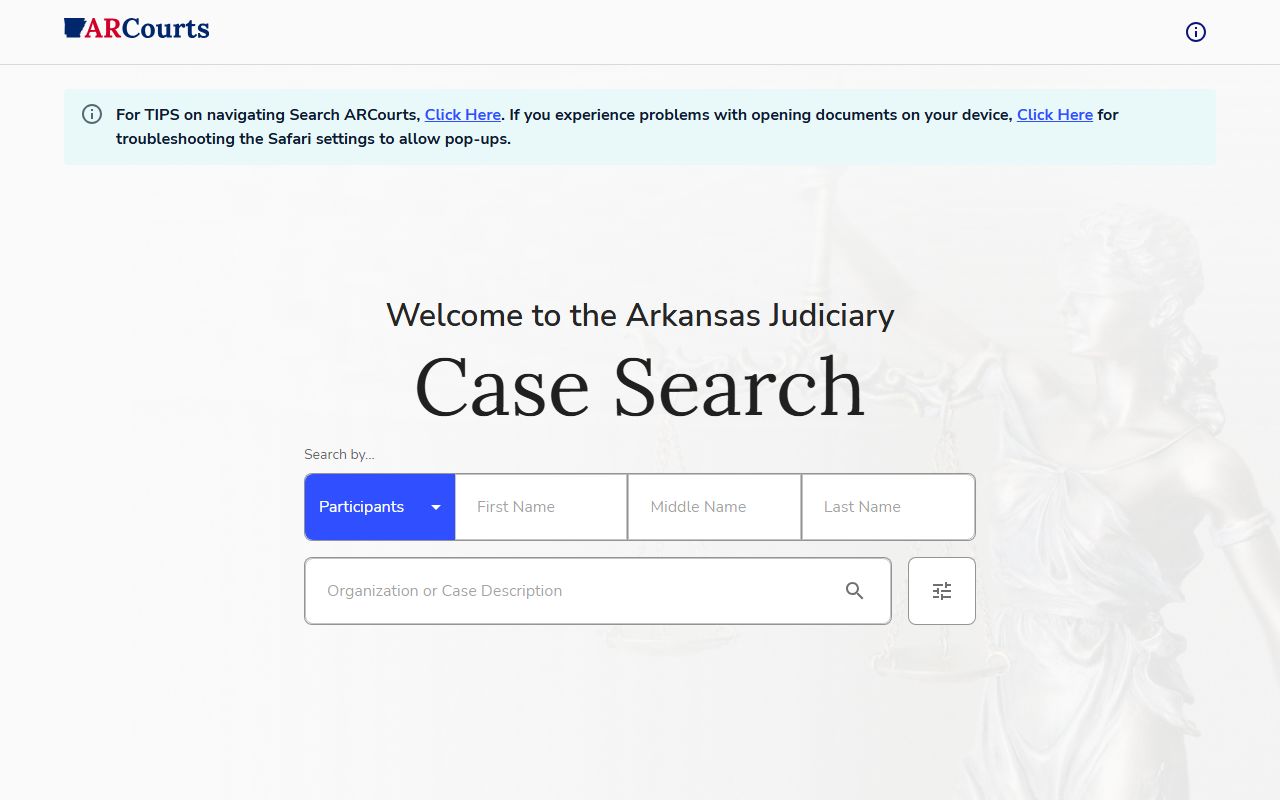
The same portal can show court charges and events, while the Columbia County jail roster remains the separate custody record.
The Arkansas Judiciary says public case records may include parties, judge, filings, charges and dispositions, future events, judgments, and sometimes linked public filings. It also warns that Administrative Order No. 19 restricts some court data from Internet access. Juvenile matters, sealed files, protected victim details, and other restricted records may be withheld online even when a clerk record exists.
- Open Search ARCourts and start with the participant search. Use the name shown on the Columbia County jail roster, including middle initial only if it helps.
- Use Columbia County, court location, case type, and date filters if the name is common. Clear stale filters before running a new search.
- Open the likely case and compare the filed charge list with the booking charge. Booking text can be brief, broad, or later changed.
- Check each event, hearing, disposition, judgment, bond entry, warrant event, and document link. If a document is absent, ask the clerk whether it is available another way.
| Search ARCourts Field | Use in a Columbia County Arrest Case |
|---|---|
| First, middle, and last name | Search for the defendant or participant; try spelling variants and initials. |
| Organization or case description | Useful when a case involves an agency or descriptive case text rather than a simple name match. |
| Date range | Narrows by filing, event, citation, or hearing period when the arrest date is known. |
| Case type and county | Separates criminal or traffic cases from unrelated civil, domestic, probate, or appellate entries. |
| Court location | Helps distinguish circuit filings from Columbia County District Court, Magnolia, Waldo, or other court locations. |
The official Search ARCourts information page gives statewide portal context and AOC help numbers. For a specific Columbia County record, the court where the case was filed is still the correct office to verify copy access, certification, or restricted-file status.
Columbia County Charges After Arrest
Columbia County is served by the 13th Judicial District Prosecuting Attorney. The prosecutor's criminal-process page describes the sequence as crime report, investigation and arrest, booking, arraignment, formal charges, pretrial hearing, trial, disposition, and sentencing. It also explains that booking creates a record of personal information and the charged offense, while the arraignment is the early court appearance where the judge informs the defendant of the charge and addresses release or bond issues.
The 13th Judicial District staff page lists Prosecuting Attorney Jeffrey Rogers and Columbia County deputy prosecutors Amy Freedman and Joel Hutcheson. The research also identifies Darla Longino as Victim Witness Coordinator for Columbia County. Those offices give charging context, but they do not replace Search ARCourts or the Circuit Clerk for public case lookup. Once the prosecutor files or amends charges, the court record controls the case status.
The prosecutor's criminal-justice process page states that formal charges are initiated through an Information, which is the formal charge against the defendant. That point is central in Columbia County court records after a jail arrest: the jail charge may be a starting label, while the court charge is the filed accusation the case follows.
Columbia County Charging Documents
A court record after a Columbia County arrest usually turns on the charging document. The research identifies complaint, information, and indictment language as the practical set to explain. Arkansas felony matters commonly use an information filed by the prosecutor, while some matters can begin with a complaint or proceed by grand-jury indictment. The document type affects how the charge enters the court file, not whether the jail roster alone proves guilt.
| Document | Who Files or Returns It | What It Means |
|---|---|---|
| Complaint | Officer or prosecutor, depending on the matter | A formal accusation used to start or support a criminal or traffic case. |
| Information | Prosecutor | The 13th Judicial District's described route for formal charges filed by the prosecutor. |
| Indictment | Grand jury | A formal charge returned by a grand jury, usually in more serious or selected felony matters. |
The absence of a scanned document link in Search ARCourts is not the same as absence of a charge. Administrative Order 19, document availability, clerk processing, or timing can limit what is visible online.
Columbia County Charge Status Records
Charge status can change after a Columbia County jail arrest. A roster card may show a short charge label and bond amount, while Search ARCourts may later show a filed count, amended count, disposition, warrant event, revocation, or dismissal. Keep each count separate. One charge can be dismissed while another remains pending, and a later plea may apply to a reduced or amended charge rather than the exact booking text.
| Status | Plain Meaning | Search Tip |
|---|---|---|
| Pending | The charge is filed and not yet disposed. | Check future events and bond conditions before assuming release or closure. |
| Amended or reduced | The prosecutor or court changed the filed count. | Compare the current charge with the original booking charge. |
| Dismissed | The court record shows the charge did not proceed to conviction. | Confirm whether other counts remain open. |
| Nolle prosequi | The prosecutor chose not to continue that charge. | Read the docket date and any remaining case entries. |
| Judgment or sentence | The case has reached a disposition by plea, verdict, or court order. | State prison custody may shift to the Arkansas DOC locator. |
For broader criminal-history questions, Arkansas ACIC records are not the same as public court records. The research cites Arkansas Code section 12-12-1008 and section 12-12-211 as controlled criminal-history access rules, not casual public roster tools.
Columbia County Warrants and Bond Caveats
Warrants and bond entries often sit between the jail record and the court record. The sheriff-linked ISOMS warrants portal is public and browsable by All or A-Z filters. It can show name, race/sex, age, issue date, city, warrant number, paper type, court, charge, bond, and bond text. It is not a keyword search system, and the research found no posted refresh frequency or removal policy.
Columbia County also publishes a district court bond and fine schedule. The schedule is useful context, but it is not a guarantee of the amount needed in a specific case. The sheriff page warns that amounts can change at District Judge Steve Crane's discretion, says mandatory-court citations cannot be handled like simple payments, and directs exact amount questions to the business office at 870-235-3740. No cash is accepted for those listed payments.
Bond caveat: A posted local bond may not release a person if a no-bond hold, parole hold, federal hold, immigration hold, or another court order remains active.
The sheriff archive also warns about scam calls claiming someone missed jury duty and must pay by phone. Warrant or bond demands should be checked through the sheriff, district court, Circuit Clerk, Search ARCourts, or the official warrant portal, not through an unsolicited caller.
Charges Versus Convictions
A Columbia County charge is an accusation. A Columbia County conviction is a final result after a plea, verdict, or other qualifying disposition. This distinction is required when reading court records after an arrest, because the jail roster may display charges before any final court outcome exists. A charge can be amended, reduced, dismissed, nolle prossed, or resolved differently from the booking label.
| Issue | Charge | Conviction |
|---|---|---|
| Stage | Filed accusation after arrest or citation. | Final result by plea, verdict, or judgment. |
| Proof level | Not a finding of guilt. | Reflects a court outcome on the record. |
| Where to verify | Search ARCourts, clerk records, and prosecutor-filed documents. | Judgment, disposition, sentencing, or clerk-certified record. |
| Public meaning | Should be described as alleged unless disposed. | May still require checking appeal, sealing, or later order history. |
Sealed Columbia County Arrest Court Records
Arkansas uses record-sealing language for many criminal-record restrictions. The research cites Arkansas Code section 16-90-1413, which describes the process after a uniform sealing order and requires clerks, arresting agencies, and criminal-justice agencies to segregate or electronically restrict sealed records from general access unless law permits access. A sealing order is not the same as a simple roster edit, and it does not automatically erase every private copy that may already exist elsewhere.
| Issue | Sealed | Expunged |
|---|---|---|
| Arkansas wording | Common statutory path for restricting public access. | Often used informally by the public, but sealing is the cited Arkansas process here. |
| Public access | General access is restricted after a valid order. | Do not assume destruction unless a specific order or law says so. |
| Agency access | Criminal-justice access may remain where law allows. | Private copies and online fragments may require separate handling. |
| Best record source | Court order, clerk record, and arresting agency response. | Clerk or lawyer review if the term appears in older records. |
For nonpublic court information, Search ARCourts may simply omit a case, field, or document. That online absence should be read with care. The Circuit Clerk or the court that handled the case can verify whether the record is public, sealed, restricted, or available only by in-person or certified-copy process.
Columbia County Court Record Limits
Arkansas FOIA opens public records for inspection and copying unless an exemption or separate law applies. The research cites Arkansas Code section 25-19-105 for public-record access and notes that a custodian may charge actual reproduction or transmission costs and need not create a new record. For jail material not online, the sheriff is the likely custodian. For filed court charges after an arrest, the clerk is the better office.
Several records should not be promised from a public page. Juvenile records, sealed cases, protected victim information, medical or mental-health information, social security numbers, active investigative material, security data, and some criminal-history information can be withheld or redacted. A requester should identify the person, approximate arrest or booking date, arresting agency, charge if known, and case number if known.
Important: Court, jail, and background-check data may not be used for employment, credit, insurance, tenant screening, or any other FCRA-covered purpose.